Blog
What AI website builders are actually for
A prompt now produces a working website in a minute. What is genuinely in that output, what is not, and who these tools were really built for.
 Miki Sharkovski
11 min read
Updated August 28, 2026
Miki Sharkovski
11 min read
Updated August 28, 2026
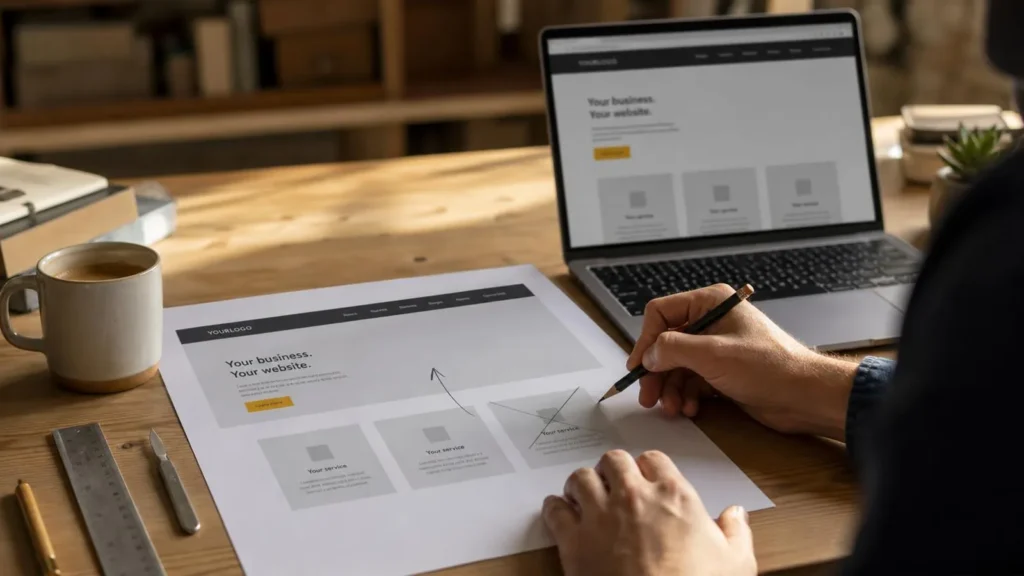
You describe your business in a sentence or two, wait about a minute, and a website appears. Pages, images, colors, buttons, a contact form. It genuinely works, it is genuinely impressive, and the first reaction is usually the same: so that is what people have been charging for.
It is a fair reaction to have, and it is worth taking the tools seriously rather than dismissing them. What follows is not an argument that they are bad. It is an attempt to answer a more useful question — what is actually in the thing you just generated, what is not, and who AI website builders were built for.
What the tool actually did
It produced a layout, some placeholder-quality copy, a color scheme, and working code for a set of common page patterns. That is production work, the assembling, and it is the part of building a website that has been getting cheaper for twenty years, first with templates, then with page builders, now with a prompt.
This part is real value and it is not going away. Producing a page used to take a day and now takes a minute, and anyone who tells you that is not a big deal is protecting something.
What it did not do, and could not have
Everything upstream of the layout, because it was never given any of it. The tool did not know your margins, which service you actually want more of, what your competitors already say, what your customers ask before they buy, or which of your inquiries waste your time.
It could not have known, because you cannot put it in a prompt — most of it is not written down anywhere. So the tool did the only thing available to it, which is to produce the statistically most typical version of a website for a business like yours.
Here is roughly what is in the output, against what a site that earns its keep needs:
What arrives with the generated site
A structure. A visual style. Responsive layout. Working forms in most cases. Passable performance on a first load, before anything real is added to it.
What does not, and has to be decided by somebody
Positioning. What you are, who you are for, and why someone should pick you over the business two streets away. A tool cannot decide this, because it is a claim about the world and you have to be willing to defend it.
Copy that came from your actual customers. Generated copy is fluent and it is about nothing. It describes a category, not a business. The strongest sentence on most websites is one somebody actually said in a meeting, and no model has access to that meeting.
Structure that follows how people buy from you. Which page comes first, what a visitor needs to believe before they will inquire, where the price conversation happens. This is a decision about your sales process that gets rendered as navigation.
Everything that only shows up under load. Speed once real images and a tracking script are added — the generated site is fast when it is empty, and the number that measures it moves more than people expect. Accessibility. Whether search engines can make sense of the page. Whether the form still delivers in six months. None of this is visible on the day the site is generated, which is exactly why it does not get checked.
Who these tools were actually built for
This is the part that gets missed, and it is not a slight on anybody.
The people getting the most out of AI website builders are, overwhelmingly, people who already know what a good site looks like. They can look at the generated output and see immediately that the hierarchy is wrong, the call to action is buried, there are four competing messages above the fold and the whole thing is a template with different photographs. Then they fix it, in minutes, because the tool removed the tedious part of a job they already knew how to do.
That is what a power tool does. It makes a skilled person faster. It does not make an unskilled person skilled, and this has never been controversial about any other trade — nobody buys a nail gun and starts framing houses.
The reason it feels different with websites is that the output looks finished. A badly framed wall looks wrong to anybody. A badly structured website looks like a website. The gap between “a site exists” and “a site works” is invisible from the outside, and it is entirely where the difference in outcome lives.
The part nobody was expecting: it is starting to show
Two years ago, generated sites were largely indistinguishable to a normal visitor. That is changing, and faster than anyone predicted.
People now recognize the patterns. The same three-column feature grid, the same gradient, the same headline shape, the same photography that is almost right, the same phrases. Most visitors could not tell you what tipped them off, and the recognition still happens — as a vague sense that they have been here before, and that nobody is home.
The commercial consequence is worth stating plainly, because it is the opposite of what most people assume. As generated work becomes cheap and everywhere, evidence of human effort becomes the scarce thing. Real photographs of your actual premises. A sentence that only your business could have written. A page that answers the awkward question your competitors avoid. Those read as care, and care is the thing being bought when someone chooses one supplier over another at a similar price.
This is the same mechanism as every other signal that makes a small business look substantial. It is not about looking expensive. It is about looking like somebody was there.
When generating it is the right call
To be fair to the tools, and because this is genuinely contested, there are cases where the generated site is the correct answer and paying anybody would be a mistake.
Testing whether an idea has any customers at all. A landing page for one campaign that will be switched off in six weeks. Something internal that no customer will ever see. A placeholder while the real thing is being built. Any situation where the site does not have to compete, only exist.
There is a version of this question that arrives earlier still, which is whether the business needs a website yet at all — for plenty of them, a social page is genuinely doing the job and the honest answer is to leave it alone for another year.
There is also an honest middle that gets ignored in this argument entirely: generate the first draft, then pay somebody to fix the four things that matter. That is a smaller, cheaper engagement than a build from scratch, and for a lot of small businesses it is the best value available. Anyone who tells you it has to be all or nothing is describing their pricing model, not your situation.
The biggest caveat: not all of these tools are the same
Everything above treats AI website builders as one category. They are not, and this is the part almost nobody buying is in a position to see.
Give the identical sentence to two of them and what comes back can differ enormously — often by more than the gap between a generated site and a cheap hand-built one. One returns something a professional could ship after a day of work. The other returns a body, a background, and three containers holding a handful of elements each.
The second one looks finished on the screen, which is the whole problem. It is a rendering of your description rather than a working website, and the difference does not surface until somebody asks it to do something.
Prompting is a skill, and it is most of the output
The same tool also produces different work for different people. Somebody who has built websites for years describes what they want in the terms the tool responds to — hierarchy, states, what happens on a narrow screen, what the form does when it fails — and gets back something shaped by those constraints.
Somebody describing their business in two sentences gets the statistically typical version, because that is all that was asked for. This is not a trick of the tools. It is the same reason a brief from someone who has commissioned ten websites beats a brief from someone commissioning their first.
What the site is built on is a decision, and most tools make it for you
Some of these tools let you choose the underlying technology. Most have a single default and never raise it, because the choice is invisible to the person buying and mentioning it would only introduce doubt.
That default is usually a framework designed for software products — the kind of thing built to run accounts, dashboards and live data. Pointed at a five-page brochure site it works perfectly well. It also means every visitor’s browser downloads and runs a considerable amount of machinery in order to display text and photographs that never change.
You have built an engine in order to switch on a light. The site is heavier than it needs to be, slower on the phones most of your visitors are actually holding, and harder to change later — and none of that is visible on the day it is generated. A surprising share of small brochure sites on the web now run exactly this way.
Why this is the caveat that matters most
None of this makes the tools bad. It makes them amplifiers, which is close to the opposite of what most people take from them.
Somebody who knows which tool to reach for, how to describe the work, and what the site should be built on gets a genuine head start. Somebody who found one site builder and published through it gets the typical version of everything, including the parts that are invisible from the outside.
Most people never learn that the choice existed. That is the honest reason these are professional tools rather than a way to save money by doing it yourself: producing a page is no longer hard, but every decision that makes the page worth having is still a decision, and these tools have quietly moved most of them out of sight.
The test that settles it
Open your generated site and try to answer three questions using only what is on the screen.
What does this business do that the next one does not? Not what it sells — what it does differently. If the answer is not on the page, no visitor is going to work it out.
What is the one thing this page wants me to do? If there are four things, there are none.
Which sentence on this page could not have been written about a competitor? If there is not one, the site is describing an industry rather than a business, and that is what a visitor comparing three tabs will conclude too.
None of those three questions is about code, and none of them is answerable by a better prompt. They are the actual job, and they were the actual job before any of these tools existed. If your generated site answers all three, keep it and spend the money elsewhere. If it answers none, you have not built a website yet — you have produced a very fast draft of one, which is a genuinely useful thing to have and a very different thing to launch.
If you would rather have somebody else answer the three questions about your site, send us the address and we will go through it and say which parts are genuinely costing you something. Plenty of the time the answer is that the site is fine and the money belongs elsewhere.
Go and try the three questions now, on the site as it stands. Whatever the answers are, you will know more about what to do next than any amount of reading about tools will tell you.
Keep reading

When a social page is genuinely enough
Plenty of businesses are sold a website too early. When a social page is doing the job perfectly…

Who your website is unusable for
It works when you test it because you know where everything is. What actually breaks for everyone else,…

What happens after you say yes
Projects stall in the middle, on the client side, over things nobody warns you about. What you will…